Teach a machine everything we know about the universe, and you might expect it to spot the cracks in that knowledge faster. The opposite can happen. A neural network trained on the standard picture of the cosmos sometimes turns that education into a blind spot, quietly forcing strange new signals into familiar old boxes. Which is awkward, because spotting strange new signals is the entire point.
That is the unexpected catch in a study just published in the Journal of Cosmology and Astroparticle Physics. The headline result is genuinely useful, even cheering for anyone who has watched a supercomputer queue crawl. But it comes stapled to a warning about what these systems do when their prior knowledge gets in the way.
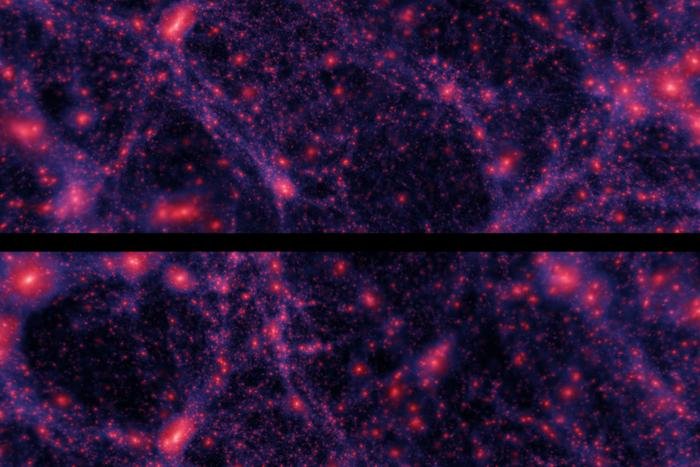
Start with the problem the researchers were actually trying to solve. Cosmologists describe the universe with a model called ΛCDM, and it works remarkably well, from the way space expands to how galaxies scatter across it. Trouble is, almost everyone suspects it is incomplete. Massive neutrinos, modified gravity, evolving dark energy: any of these could be lurking just past the edge of the standard model, and testing for them means running vast suites of simulated universes, each one expensive, each one nudged by slightly different physics. The computational bill is enormous.
A Shortcut Borrowed from Language Models
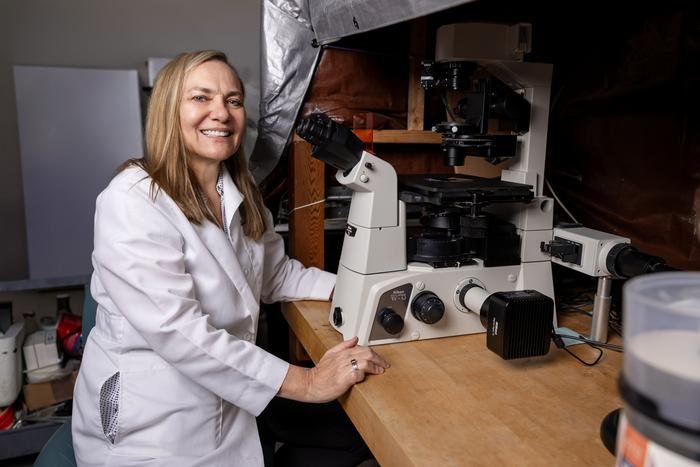
So Veena Krishnaraj, an undergraduate at Princeton University, and her colleagues tried a shortcut. The technique is called transfer learning, and if you have used a modern chatbot you have already met its logic.
“It’s basically a shortcut,” says Adrian Bayer, a cosmologist at the Flatiron Institute and Princeton University and a co-author of the paper. “Usually people train the AI directly on the most computationally expensive simulations. What we do instead is first use simpler and less expensive ΛCDM simulations to give the AI an idea of what’s happening, and only afterward move to the more complex models.”
Bayer reaches for a homely comparison. You first read a basic book to get an idea of the knowledge, he says, and then move to the really complicated book. Krishnaraj puts it another way: the approach spares the network from having to “digest everything at once.” And on paper it pays off handsomely. In some cases, pretraining on the cheap standard-model universes cut the number of expensive beyond-ΛCDM simulations needed by more than a factor of ten. Since those plain ΛCDM simulations are already lying around from other survey work, the pretraining stage is, for practical purposes, close to free.
When Knowing Too Much Backfires
Then the textbook analogy turns on them. Imagine reading that introductory medical text, then meeting a rare disease whose symptoms mimic a common one. Your hard-won grounding now tugs you toward the wrong diagnosis. Networks, it turns out, can fall into the same trap, and the researchers gave it a name: negative transfer.
It showed up most sharply with massive neutrinos. Neutrino mass leaves a fingerprint on cosmic structure that looks a lot like the effect of a standard ΛCDM parameter called σ8, which measures how strongly matter clumps together. The pretrained network, having already learned to read certain small-scale patterns as σ8, kept reading them that way, even when the real culprit was the neutrinos. It had to unlearn its own training and reassign those features, and that unlearning cost it dearly.
“The negative transfer is not random. It is driven by underlying physical degeneracies in the model,” says Krishnaraj. Two different bits of physics produce nearly the same observable smudge, and the AI, sensibly enough, picks the explanation it already knows. The team confirmed the diagnosis by stripping out the small scales where neutrinos and σ8 masquerade as each other; do that, and the confusion melts away, which is about as clean a smoking gun as cosmology tends to offer.
Not every alternative universe gave them grief. Modified gravity behaved much like the neutrino case, with solid gains. Equilateral-type primordial non-Gaussianity, where the physical signatures stay distinct and the degeneracies are mild, transferred nicely. The architecture mattered too: the winning design tucked extra “dummy” nodes into the network during pretraining, leaving slack capacity for the new physics to colonize later, rather than freezing the old knowledge rigidly in place.
The bigger resonance here is with the foundation models behind today’s generative AI, the sprawling systems pretrained on one giant corpus and fine-tuned for everything else. Cosmology is now asking whether ΛCDM can play that foundational role for the physics of the universe. The answer, on this evidence, is a qualified yes, with the same caveat the paper states plainly: pretraining can accelerate inference, but may also hinder learning new physics. “So this is something we need to be aware of and try to mitigate,” Krishnaraj says.
For now the method has only been let loose on simulations, not real sky. But the next generation of cosmological surveys will pour out data at a rate no one can simulate their way through by brute force, and a tool that learns new physics cheaply, if handled with care, is exactly what that flood will demand. The trick, it seems, is building machines clever enough to know when to trust what they have learned, and when to set it aside.
Krishnaraj, V. et al. (2026), Journal of Cosmology and Astroparticle Physics, JCAP06(2026)026
Frequently Asked Questions
Why would teaching an AI more about the universe make it worse at finding new physics?
Because the knowledge it absorbs during training can act like a set of fixed expectations. When a genuinely new effect happens to resemble something the AI already recognizes, it tends to file the newcomer under the familiar label rather than flagging it as novel. Cosmologists call this negative transfer, and it shows up precisely when two different bits of physics leave nearly identical fingerprints in the data.
How does transfer learning actually save on computing costs?
Simulating universes with exotic physics is far more expensive than simulating the standard model. By first training a network on cheap standard-model simulations and then fine-tuning it on a much smaller batch of the costly ones, researchers cut the number of expensive runs needed, in some cases by more than tenfold. The standard-model simulations are often already available from other projects, so that first stage is essentially free.
Is this the same idea as the AI behind chatbots?
Conceptually, yes. Large language models are pretrained on one enormous body of data and then adapted to specific tasks, and this study tests whether the standard model of cosmology can serve as a similar foundation for the physics of the universe. The promise and the pitfalls turn out to mirror each other: a strong starting point speeds things up, but can also bias the system against recognizing something truly unfamiliar.
What’s stopping this from being used on real telescope data right now?
So far the approach has only been tested on simulated universes, which gives researchers a controlled setting to study where it works and where it stumbles. Applying it to real observations is the next step, and it is likely to matter a great deal as upcoming surveys produce far more high-precision data than anyone can simulate by force alone.