The swing of a leg lasts less than half a second. In that sliver of time, the foot leaves the ground, travels forward, and lands again, and the brain has to orchestrate the whole thing while keeping the body upright. For people with Parkinson’s disease, that orchestration falters. Steps shorten, lurch, lose their symmetry, and then someone falls.
A team at the University of California, San Francisco has now built a brain stimulator that catches each of those moments as it happens. Implanted deep in the brain, the device reads the neural signature of a single step and adjusts its output within fractions of a second, ramping the stimulation up and then down again before the foot has even landed.
Deep brain stimulation is not new. For decades it has steadied the tremors and eased the stiffness of Parkinson’s, which affects more than 10 million people worldwide, by delivering a constant electrical pulse to a target buried beneath the cortex. The trouble is the word constant. A standard stimulator hums along at the same fixed setting whether you are asleep, sitting still, or trying to cross a busy road, and walking, it turns out, is exactly the sort of fast, shifting behaviour that a fixed setting handles poorly.
“Difficulty walking is one of the most disabling symptoms of Parkinson’s disease and one of the hardest to treat,” says Doris Wang, a neurosurgeon at UCSF and senior author of the study, published in Nature Medicine. Tremor responds. Gait, frustratingly, often does not.
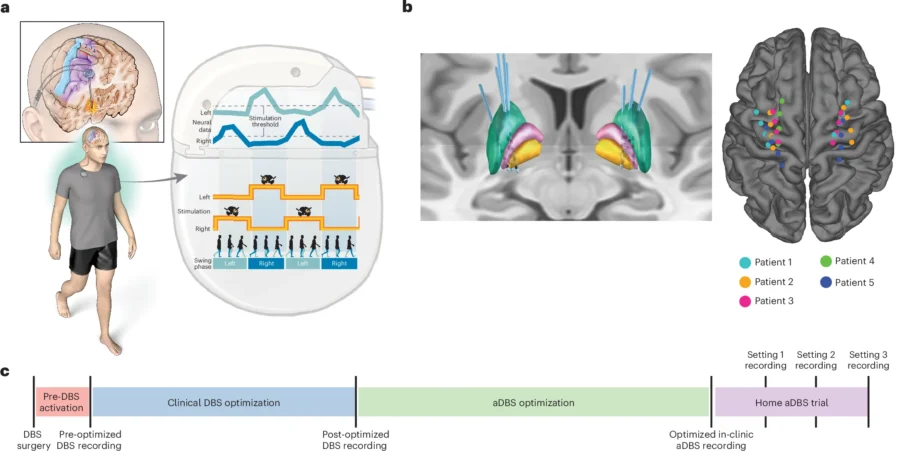
So Wang’s team tried something different. Rather than tuning the stimulator to the slow drift of a patient’s overall disease state, the approach more common in so-called adaptive systems, they tied it directly to the act of walking itself. Five people with Parkinson’s, all of whom had already undergone surgery for stimulation, also had research electrodes laid over the movement areas of the brain. With these, the researchers went hunting for the electrical fingerprint of a leg in motion.
The fingerprint of a single step
What they found is that the brain is positively chatty about walking. “The brain contains remarkably rich information about movement,” says first author Kenneth Louie, a postdoctoral scholar at UCSF. The team sifted through field potentials recorded from the pallidum and the motor cortex, searching across frequencies for a band that reliably flagged the swing of the opposite leg. In every one of the five patients, they found one.
Here is the genuinely surprising part. The textbook would point you to beta-band activity, the rhythm most associated with Parkinson’s slowness and rigidity. But the bands that actually worked best were idiosyncratic, personal, sometimes sitting well outside the canonical ranges entirely; in one patient the winning signal landed at 42 to 44 hertz, in the low gamma range nobody would have predicted. Each brain, and often each hemisphere of the same brain, had its own tell. Those personalised signatures were then loaded onto the implanted neurostimulator, a bidirectional Medtronic device that can both read the brain and stimulate it, so the whole loop ran on the implant with no external computer in the chain. During the swing of the contralateral leg, the device pushed stimulation up to the patient’s full clinical dose; the rest of the time it eased back to half. On average it caught the right moment about 19 per cent better than chance, ramping in as little as 100 milliseconds, which is roughly the blink of an eye, give or take.
“We found that we could identify neural signatures linked to each step and use them to guide stimulation in real time,” says Louie.
Fewer falls, but no magic
In the clinic, the adaptive setting tightened up patients’ gait, evening out the length and timing of their steps compared with conventional stimulation. Then three of the five took the system home for a blinded, multi-day trial, switching between the adaptive mode and their usual constant setting without knowing which was running. During the adaptive periods, they fell less often, and the difference was statistically real rather than wishful, while their other Parkinson’s symptoms stayed under control. No serious side effects turned up, and people tolerated the rapid-fire adjustments without complaint.
It is worth not overselling this. Five patients is a tiny cohort, the kind that establishes feasibility rather than proof, and the gains were uneven. The adaptive mode reduced falls but did nothing for freezing of gait, that sudden glued-to-the-floor sensation that is a separate misery. Several patients actually reported feeling stiffer on the new setting. And one man, whose stimulation had never been stable and who had needed well over a year of tinkering just to find a workable dose, got no gait benefit at all.
Still, the principle holds, and the principle is the point. Conventional stimulation may help precisely because it jams pathological brain chatter, the so-called information lesion, but in doing so it might also be drowning out the rhythmic cues a body needs to coordinate a walk. By stimulating only during the vulnerable phase of each step and backing off the rest of the time, the adaptive approach seems to leave those physiological windows open.
“This study is about more than walking,” says Wang. “It demonstrates that brain stimulation can adapt to what a person is doing in real time. That opens the door to future therapies that respond dynamically to movement, speech, mood, cognition, and other brain functions.” A device that already listens for a footstep could, in principle, learn to listen for the tremor before a sip of coffee, or the neural weather of a darkening mood.
Wang reaches for an older revolution to explain where this might go. “Just as pacemakers transformed the treatment of heart disease, intelligent neurostimulators may transform how we treat disorders of the brain.” The heart found its responsive metronome half a century ago. The brain, step by deliberate step, may be getting one now.
DOI / Source: https://doi.org/10.1038/s41591-026-04434-2
Frequently Asked Questions
How is this different from the deep brain stimulation people already get for Parkinson’s?
Conventional deep brain stimulation delivers a constant, fixed pulse all day long, regardless of what the person is doing. The UCSF system instead reads the brain’s signals in real time and changes its output during each individual step, raising stimulation as the leg swings forward and lowering it the rest of the time. That makes it responsive to behaviour rather than simply switched on.
Does it actually stop people from falling?
In this early trial, three patients who took the device home fell less often when the adaptive mode was running, and the reduction was statistically significant. That said, only five people took part overall, so this establishes that the approach is feasible and safe rather than proving it works for everyone. Larger trials will be needed before anyone can call it a reliable fall preventative.
Why does the timing of stimulation matter so much?
Walking depends on precisely timed signals coordinating both sides of the body, and one theory holds that constant stimulation, while it suppresses harmful brain activity, may also blur the rhythmic cues a body needs to coordinate a step. By stimulating only during the most vulnerable phase of each stride and easing off otherwise, the adaptive system appears to leave those useful signals intact.
Could this same idea be used for other conditions?
That is the longer-term hope. The researchers argue that a device able to respond to one behaviour, walking, could in principle be trained to respond to others, including speech, mood and cognition. The technology is still experimental, but it points toward brain implants that act only when and where they are needed.
Did it help with every Parkinson’s symptom?
No, and the limits are telling. The adaptive setting reduced falls but had no effect on freezing of gait, the sudden sensation of being stuck to the floor, which appears to be a separate problem. Some patients also reported feeling stiffer on the new setting, and one saw no gait benefit at all.