The Roman Pantheon’s unreinforced concrete dome has stood for nearly 1,900 years and remains the largest of its kind on Earth, partly because its builders mixed in lighter volcanic rock near the top and left a 27-foot hole open at its center.
The Pantheon’s concrete dome has been holding itself up in the middle of Rome since roughly 128 CE, when the emperor Hadrian’s builders closed the last ring of a 142-foot span with a 27-foot hole punched through its crown. Nearly 1,900 years later, it is still the world’s largest unreinforced concrete dome, unmatched by anything poured in steel-reinforced modernity. No rebar. No tension cables. No internal skeleton. Just a graded recipe of lime, seawater, volcanic ash and progressively lighter stone, arranged with such care that the dome effectively shrinks in weight as it climbs toward the sky.
The hole at the top — the oculus — is not a flaw. It is structural. It is also the only source of daylight inside.

A dome older than most countries
The Pantheon was rebuilt by Hadrian around 126 to 128 CE on the site of an earlier temple by Marcus Agrippa, whose name still sits across the portico in bronze letters. The inscription is a piece of Roman humility theater — Hadrian kept his predecessor’s credit line. What he built behind it was something no one had attempted at that scale: a hemisphere of concrete 43.3 meters across, resting on a drum of the same interior height, so that a perfect sphere could be inscribed inside the room.
For over a millennium after Hadrian, nothing on Earth beat it. Brunelleschi’s dome in Florence, finished in 1436, is wider by a hair but built of brick in a double-shell system with hidden chains. The dome of St. Peter’s is taller but smaller in diameter and heavily reinforced with iron rings. The U.S. Capitol dome is cast iron. Modern stadium domes rely on steel. The Pantheon is still the largest unreinforced concrete dome in the world.
The recipe changes as you look up
The trick that has kept the Pantheon standing is not one trick. It is a stack of them, and the most elegant is the aggregate gradient. Roman builders knew that the weight bearing down on the base of a dome is what threatens to push its walls outward. So they made the dome lighter the higher it went.
At the base of the dome, near the springing point where it meets the drum, the concrete is packed with dense aggregate — broken travertine and heavy chunks of brick. As the dome rises, the aggregate shifts to lighter volcanic tuff. Near the oculus, the mix uses pumice, the frothy volcanic rock so full of trapped gas bubbles that it floats on water. The concrete at the crown weighs roughly a third less than the concrete at the base. The dome is, in a real sense, sculpted out of density itself.
The walls follow the same logic. The drum below the dome is thick at the bottom and thins as it rises. The dome itself is thickest where it meets the walls and thinnest at the oculus. Less material where less material is needed. More where the loads concentrate.
Why the hole doesn’t wreck it
The 27-foot oculus looks like the most dangerous feature in the building. It should be a weakness — a giant missing piece of the shell. It is the opposite. Domes fail when the ring of masonry near the top gets pushed apart by the weight of everything below trying to spread outward. The oculus is ringed by a thick compression ring of brick and concrete, and by removing the material that would otherwise sit at the very apex, the builders eliminated the load that would have concentrated there. The hole makes the geometry work.
It also lets in the rain. Anyone who has stood inside the Pantheon during a Roman storm has watched water fall in a clean cylinder through the middle of the room. The marble floor is very gently domed and drilled with small drainage holes, most of them still functional, that carry the water into the ancient sewer system beneath.
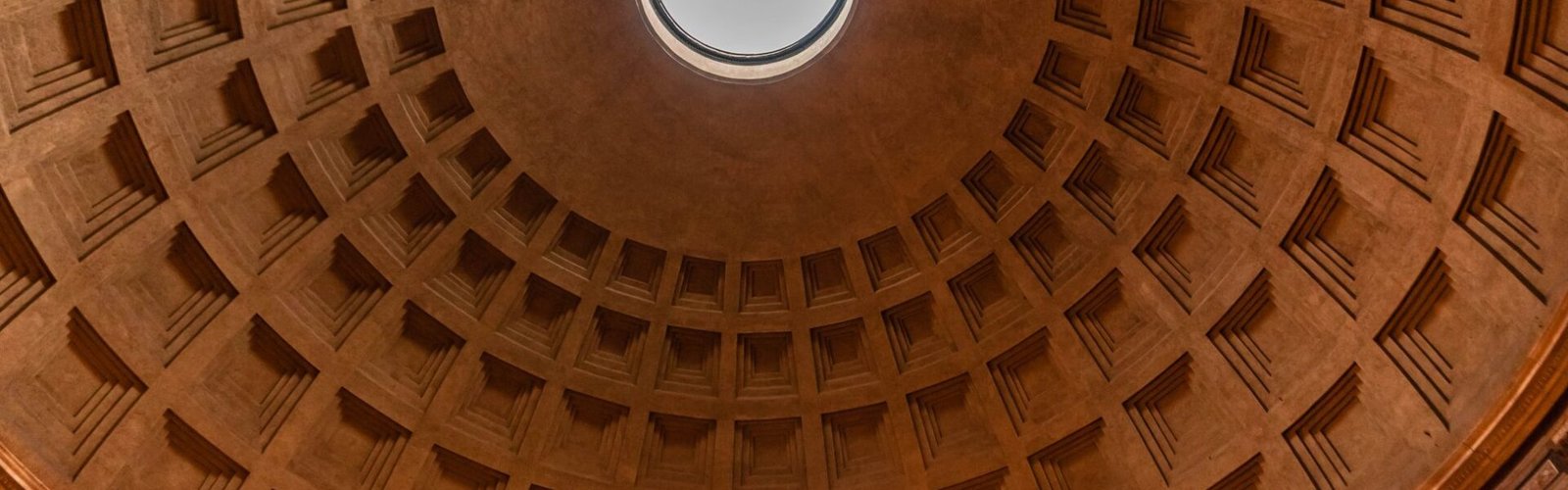
Inside the coffered ceiling, rings of recessed square panels step upward toward the oculus, each ring smaller than the last. The coffers are not just decorative. They shave weight off the dome without weakening its structural shell, taking out material from the parts of each panel that were doing the least work.

The concrete itself is doing something strange
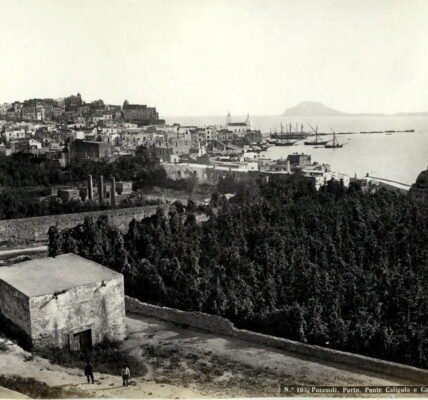
Roman concrete — opus caementicium — has been studied for a long time, but only recently have researchers understood why it lasts. For years the consensus was that the Romans used a mix of lime, volcanic ash (particularly the ash from the Pozzuoli region near Naples, called pozzolana), water, and rubble aggregate, and that the volcanic ash reacted chemically with the lime to form crystals that locked the whole mass together.
That was only part of the answer. In 2023, an MIT-led team looking at samples from the archaeological site of Privernum found bright white chunks — lime clasts — that earlier scholars had dismissed as sloppy mixing. They turned out to be the point of the whole system. When cracks form in the concrete and water seeps in, the water dissolves calcium from those clasts and carries it into the crack, where it recrystallizes as calcium carbonate. The concrete heals itself.
The researchers confirmed the mechanism by casting fresh concrete using the Roman recipe with lime clasts, deliberately cracking it, and running water through the cracks. Within two weeks, the cracks had sealed. A control batch made without the clasts leaked indefinitely.
The clasts appear to have been produced by “hot mixing” — adding quicklime directly to the mix rather than slaking it into a paste first, a violent reaction that leaves behind small pockets of reactive calcium. Roman writers, including Vitruvius, had described careful slaking and would have called hot mixing a mistake. The concrete itself contradicts him.
A study of an unfinished construction site at Pompeii, buried mid-pour by the eruption of Vesuvius in 79 CE, caught Roman builders in the act and confirmed that hot mixing was standard practice, not error. The Pompeii evidence shows workers combining quicklime with dry pozzolana and only then adding water — a process that generates enough heat to accelerate curing and produce exactly the lime clasts MIT identified.
Seawater made it stronger
Roman harbor structures did something even stranger. Concrete piers at coastal sites have been sitting in seawater for two millennia, and instead of eroding they have gotten harder. Marine chemists studying Roman marine concrete found that seawater percolating through the mix reacts with volcanic ash to grow rare crystals that reinforce the matrix from within. Modern Portland cement, by comparison, begins to fail in salt water within decades.
The Pantheon is not a marine structure, but the same underlying chemistry — volcanic ash reacting with lime and moisture over centuries — is still forming calcite cements inside its walls today, filling microcracks as they open. The building is, in a slow way, still curing.
What the builders knew without knowing
Hadrian’s engineers did not have chemistry. They did not know that their quicklime was producing self-healing calcium reservoirs, or that their pozzolana was a source of reactive aluminosilicates. What they had was two centuries of trial and error and a working empire’s worth of construction data, from aqueducts to bath complexes to the harbor at Caesarea. They knew that certain ashes from certain volcanoes made concrete that survived floods. They knew that heavier aggregate at the base and lighter aggregate at the top let a dome hold itself up. They knew that a hole at the crown was safer than a plug.
The Pantheon has survived earthquakes, the sack of Rome in 410, the collapse of the Western Empire, the Middle Ages, the stripping of its bronze roof tiles in the seventh century, and the melting down of bronze from the portico in the seventeenth century to make cannons — an act that produced the Roman pasquinade, “what the barbarians did not do, the Barberini did.”
The concrete kept holding.
Why modern concrete doesn’t do this
Ordinary Portland cement, the binder in nearly every sidewalk and skyscraper poured since the 19th century, has a working design life of 50 to 100 years. Reinforced concrete, the kind used in bridges and parking garages, can fail faster because the steel rebar inside rusts, expands, and cracks the concrete from within. American infrastructure engineers have spent decades watching mid-20th-century bridges and overpasses spall and crumble on schedules the Romans would have found bewildering.
The MIT team behind the lime-clast discovery has been working on commercializing a Roman-inspired formula that would extend the life of modern concrete and reduce its carbon footprint — cement production is currently responsible for around 8 percent of global CO2 emissions, and any recipe that lets a structure last four times as long cuts that footprint proportionally. A separate line of research at Pompeii is reconstructing the exact mixing sequence used by first-century builders, hoping to reverse-engineer the durability at industrial scale.
Standing under the hole
The Pantheon is a working church now, Santa Maria ad Martyres, consecrated in 609. Mass is held there. Raphael is buried inside, along with two Italian kings. Tourists queue in the Piazza della Rotonda in the mornings and step through the bronze doors into a room that has not fundamentally changed in nineteen centuries.
At noon on a clear day the sun comes through the oculus as a perfect disc, roughly eight meters wide, and tracks across the coffers on the interior of the dome as the Earth turns. On April 21, the traditional founding date of Rome, the shaft of light strikes the metal grille above the entrance doorway at midday, illuminating anyone who happens to be standing there. Hadrian’s architects almost certainly planned this. Nearly nineteen hundred years later, the alignment still works, because the concrete has not moved.