Chemists Can Now Rewrite a Drug Molecule in a Single Step Instead of Building It From Scratch
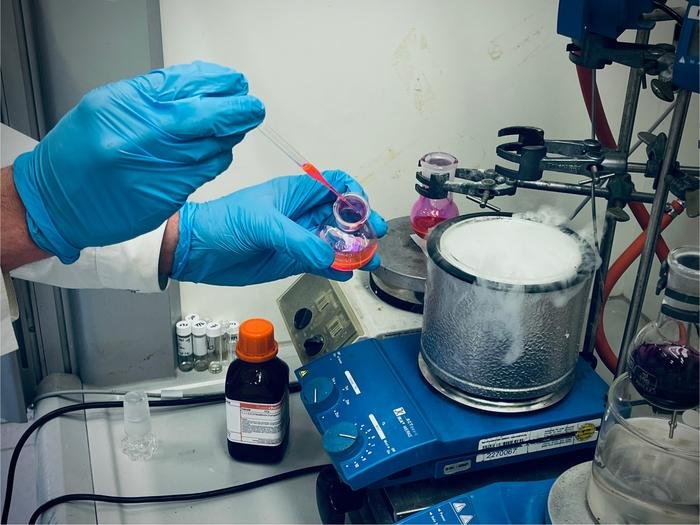
The vial does not look like much. A pinch of paraformaldehyde, a splash of solvent, a known antidepressant tipped in as its hydrochloride salt, and an unremarkable hydrocarbon you could buy by the barrel. Seal it, warm it to 75 degrees, leave it overnight. By morning the fluoxetine inside, the active ingredient in Prozac, has become something else, its molecular tail swapped for a new one without a single protecting group, metal catalyst, or light source in sight. No painstaking rebuild. Just an edit.
That, more or less, is what a team at the University of Vienna has pulled off, and it upends a habit chemists have kept for over a century. For roughly a hundred years the craft has run one way: to make a complex molecule, you assemble it bond by bond, atom by atom, from simpler pieces. The Vienna group, led by the organic chemist Nuno Maulide, went after a different verb. Rather than rebuild a molecule, why not rewrite the part you want to change and leave everything else alone?
Their target was a workhorse class of compounds called secondary N-methylamines, in which a nitrogen carries a single methyl group, a tiny CH₃ cap that turns up in an enormous fraction of marketed drugs. The team calls its trick “Alkyl Swap.” Reported in Nature Chemistry, it takes that methyl cap and trades it for a far more elaborate fragment, in one pot, in one step.
Why all the fuss about amines? Because they are, in a real sense, the chemistry of being alive.
“Amines are everywhere. Proteins, drugs, neurotransmitters. Practically all biological processes depend on amines. This makes the ability to directly and selectively modify such structures all the more important,” says Uroš Vezonik, a PhD student in the group and co-first author of the paper. The flip side is that synthetic, non-natural amines tend to hit biological systems hard precisely because the body is so fluent in the natural ones.
The trouble with the methyl group
Here is the catch that has dogged the field. The carbon bonds clustered around an amine’s nitrogen all look maddeningly alike, and the one chemists most wanted to touch, the methyl, has tended to be the hardest to reach selectively. Existing routes leaned on fussy transition-metal catalysis, photoredox setups, or sensitive reagents, and most refused to work on an unprotected amine. In a much-cited study, David MacMillan’s group functionalized the methyl group of fluoxetine, but only after capping the amine with a protecting group first; strip that cap off, and the reaction gave nothing. The free NH, it turned out, sabotaged the whole thing.
Maulide’s team sidestepped the problem rather than muscling through it. The recipe sounds almost too plain: take the secondary methylamine, add a cheap alkene, throw in formaldehyde as a source of a single carbon, and let an internal shuffle of a hydrogen atom do the heavy lifting. Mechanistically, the formaldehyde and the amine condense into a reactive iminium ion; the alkene latches on; a hydrogen migrates internally in what the chemists call a 1,5-hydride transfer, a sort of molecular sleight of hand that resets the books; and a second iminium forms, collapsing on workup into the new amine. Deuterium labelling, where heavy hydrogen atoms serve as tracers, pinned down both halves of this story, with 97 per cent of the label landing exactly where the mechanism said it should. The upshot is a clean, linear product every time, even on benzyl-bearing amines that nearly every rival method would have grabbed at the wrong spot.
“What’s fascinating is the simplicity,” says Daniel Kaiser, a co-author. “You can modify highly complex molecules at a very specific point without touching the rest of the molecule.”
Bathtub chemistry
And it really is simple, almost insultingly so by the standards of modern synthesis. No glovebox, no rigorously dried solvents, no special lamps. Maulide has taken to calling it “bathtub chemistry.” “The reaction is so simple that, in theory, you could even do it in a (heatable) bathtub,” he says, before adding, drily, “Of course, we still recommend a lab.” The robustness is not just a punchline, mind. A reaction that tolerates water and air and an inventory of touchy functional groups, halides, esters, alcohols, phosphonates, even free-standing ketones and aldehydes, can be let loose on the kind of fragile, over-decorated molecules that real drug candidates tend to be.
To show it off, the team ran the method across a roll-call of familiar medicines: duloxetine, sertraline, atomoxetine, citalopram, pseudoephedrine, a dozen-odd others, each edited at a single defined position. Then they went further, building several marketed drugs outright in one step from a plain olefin and a methylamine, among them cinacalcet, made on gram scale, and the antifungal naftifine. Where the older fluoxetine method needed its protecting group, this one took the unprotected drug and obliged.
“This allows us to functionalize complex amines that could not be transformed in this way with any other known method,” says Giulia Iannelli, the paper’s other co-first author. “That’s what makes this process so valuable.”
There are limits, naturally. Anilines without an ortho substituent veer off into an unwanted side reaction, and a few substrate classes still sit outside the method’s reach. This is a new disconnection, not a universal solvent for synthesis, and whether it scales gracefully from a clever bench demonstration to routine industrial use is the question that always lingers over work like this.
Still, the prize on offer is the one drug hunters care about most: speed. Modern medicinal chemistry lives or dies by how fast you can make and test hundreds of slightly different versions of a promising molecule, and a one-step edit that spares you the full rebuild each time could compress that grind dramatically. The logic reaches into trickier territory too. The Vienna chemists used their swap to assemble PROTACs, the two-headed molecules that drag disease proteins to the cell’s shredder, and to staple a drug onto a peptide, both jobs that normally demand a more roundabout chemistry.
What Maulide keeps returning to, though, is not the list of products but the change of mindset. “What excites us most is the new way of thinking that this method enables,” he says. “Suddenly, molecules that were previously extremely difficult to synthesize become much more accessible.” If editing starts to feel as natural to chemists as building once did, the question stops being how you make a molecule and becomes which part of it you would like to change.
DOI / Source: https://doi.org/10.1038/s41557-026-02178-7
Frequently Asked Questions
Why does editing a molecule beat building it from scratch in drug research?
Because testing a new medicine means making and screening hundreds of near-identical variants, and rebuilding each one bond by bond is slow. A method that swaps out just the part you want to change, in a single step, could collapse weeks of synthesis into an afternoon. That speed is exactly where this Vienna work aims to make its mark.
Is it true you could run this reaction in a bathtub?
The lead chemist says so, half in jest: the reaction tolerates water and air and needs no special catalysts or light, so it could in theory run in a heatable tub. The serious point is its robustness, since most rival methods demand bone-dry, oxygen-free conditions. He still recommends doing it in a lab, for what it is worth.
How does the alkyl swap actually replace one piece of a molecule?
Formaldehyde and the amine first join to form a reactive species called an iminium ion; a cheap alkene then attaches, and a hydrogen atom migrates internally to reset the molecule into a new, longer amine. Tracer experiments using heavy hydrogen confirmed the steps almost perfectly. The result is a single, clean product at one precise location every time.
Could this be used to make drugs that were hard to synthesize before?
That is the central claim: the team built marketed medicines like cinacalcet and naftifine in one step, and edited an unprotected version of fluoxetine that older methods could not touch. They also used it to assemble complex constructs such as protein-degrading PROTACs and drug-bearing peptides. Whether it generalizes to every awkward target is still being worked out.
What’s stopping this from working on any molecule?
It is not universal. Certain aniline compounds veer into an unwanted side reaction, and some substrate classes remain out of reach, so it is a powerful new option rather than a catch-all. The bigger open question is whether a neat bench result holds up at industrial scale.