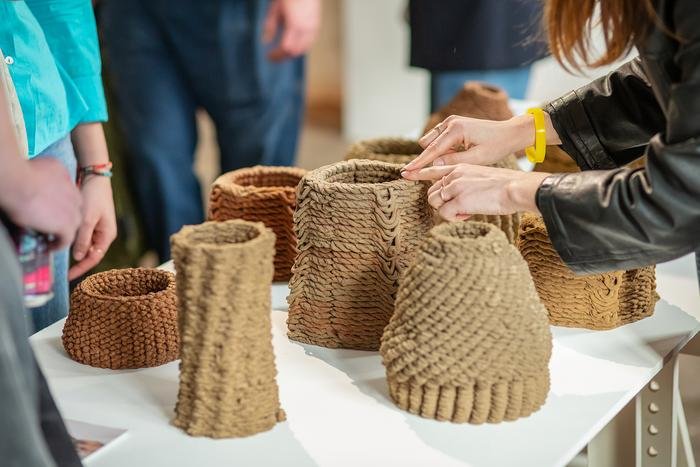
A nozzle moves back and forth over a print bed, laying down ribbons of wet earth, one 8-millimetre layer at a time. The wall it builds leans outward as it rises, tilting past 60 degrees, steeper than the Leaning Tower of Pisa, and it does not topple. The mud holding that angle is mostly clay and sand dug from a granite quarry near Golden, Colorado. What keeps it standing is a pinch of something you have almost certainly eaten: the seaweed extract that gives ice cream its smooth, scoopable body.
That extract is sodium alginate, and its starring role in a 3D printer is the surprise at the heart of work led by engineers at the University of Colorado Boulder. The result, published in Nature Communications, is less about a single clever additive than about dragging a very old craft into the lab.
People have raised shelter from earth for as long as there have been people to shelter. “From termite mounds to adobe buildings, humans and animals have been building with earth since the dawn of time,” says Wil Srubar, a professor of civil, environmental and architectural engineering who led the team. But the know-how has mostly lived in the hands, passed builder to builder. There hasn’t been much science to how earthen builders design their materials, Srubar says, and that gap is exactly what he wanted to close, using scientific knowledge and tools to understand it.
Nature, it turns out, has been running this experiment for a very long time. Termites pile up towering mounds; wasps fold intricate nests; honeycomb worms cement reef-like tubes along the coast. None of them mix cement. They use biopolymers, large biological molecules, often spun from saliva, that act as glue to bind soil and grit into something load-bearing.
Five glues, one surprise
So the team went shopping in nature’s pantry. They tested five biopolymers, all of them familiar from the supermarket: guar gum, locust bean gum and cassia gum, the legume-derived thickeners that keep salad dressing from splitting; xanthan gum, brewed by fermenting sugar; and sodium alginate, pulled from brown seaweed. Each was mixed into clay and sand to see which could turn loose earth into something a printer could handle. The expectation, reasonably enough, was that the best binder would win.
Locust bean gum was the obvious candidate. It gripped the soil particles and knitted them into a stronger network, exactly what a glue should do. The trouble is that the same grip made the paste stiff and stubborn, fighting every push through the printer’s nozzle. A great binder, in other words, makes a lousy ink.
Sodium alginate did something stranger, and far more useful. Rather than gluing the particles together, it rearranged the electrical charges on the clay, nudging neighbouring particles to repel one another, the way two magnets shove apart when you turn them the wrong way round. That repulsion let the particles hang in a stable suspension while still sliding smoothly out of the nozzle. The team had gone looking for a better adhesive and found that the trick was to make the mud less sticky, not more. To natural earth from the Golden quarry they added just 0.12 per cent alginate, a vanishingly small dose, and got a material that withstood 25 per cent more pressure than plain earth and printed about a third faster. It also shrank far less as it dried, which matters, because shrinking is how earthen walls crack.
Reading 90 per cent of the planet’s dirt
The point of all this fuss over charges and gums is reach. Rather than perfecting one recipe for one patch of ground, Srubar’s team, working with colleagues at Columbia University, picked apart the chemistry that decides whether a given biopolymer will bind or disperse a given mineral, then checked it against the clays that make up roughly 90 per cent of the world’s subsoils. One finding upends a piece of engineering folklore: sand, long dismissed as inert filler, turns out to shape how the whole mixture behaves. That kind of map is the difference between a laboratory curiosity and something a builder in another country could actually use.
It is worth being sober about what has and hasn’t been shown. The walls here are demonstrators, printed on a lab-scale machine, not load-bearing structures weathering a winter, and the study set out to crack printability rather than long-term strength or durability, which remain to be tested under real sun, rain and damp. A 60-degree overhang is a fine party trick; a house is a harder ask.
Still, the case for bothering is not really aesthetic. Earth is an excellent thing to live inside. “There are some good indoor environmental benefits of having earth in a building,” says Samuel Armistead, a research associate on the team. Earthen walls can buffer indoor humidity, draw in air pollutants and act as a thermal flywheel, holding rooms cooler in summer and warmer in winter, all without the carbon bill that cement carries. And the raw material is often already on site, in inconvenient heaps. Every basement, foundation and underground car park starts with diggers hauling out tonnes of soil, most of which is trucked off to landfill. Reusing that waste earth where it sits, Armistead says, could sharply cut construction’s environmental footprint.
That is the wager worth watching. Clay and sand are, as Srubar puts it, “among the most abundant building materials on Earth,” spread under nearly every place humans want to live. If the chemistry that makes them printable really does travel, then the future of low-carbon construction might be sitting in the spoil heap outside, waiting for the right pinch of seaweed.
Source: Armistead et al., Nature Communications (2026), DOI 10.1038/s41467-026-71885-z
Frequently Asked Questions
Why would you put an ice cream ingredient into a wall?
Sodium alginate, the seaweed extract that smooths ice cream, changes the electrical charges on clay particles so they gently repel one another. That keeps the earth mixture stable but flowing, so it slides through a 3D-printer nozzle instead of clogging it. Counterintuitively, the additive works by making the mud less sticky rather than gluing it together.
How much stronger does the earth actually get?
Adding just 0.12 per cent sodium alginate to natural earth let it withstand about 25 per cent more pressure than plain earth and print roughly a third faster. It also shrank far less while drying, which is one of the main ways earthen walls crack. The team printed walls that leaned past 60 degrees without collapsing.
Is printing with dirt really better for the environment?
Earth is abundant, non-toxic and carries none of the carbon cost of cement, and earthen walls can buffer indoor humidity and temperature on their own. Construction also digs up huge volumes of soil for foundations and basements, most of which is sent to landfill. Reusing that waste earth on site could cut a project’s footprint considerably.
Could you build an actual house this way tomorrow?
Not quite yet. The walls in this study are lab-scale demonstrators, and the work focused on making earth printable rather than proving long-term strength or weather resistance. Those durability questions, under real sun, rain and humidity, still need answering before earthen printing reaches the building site.